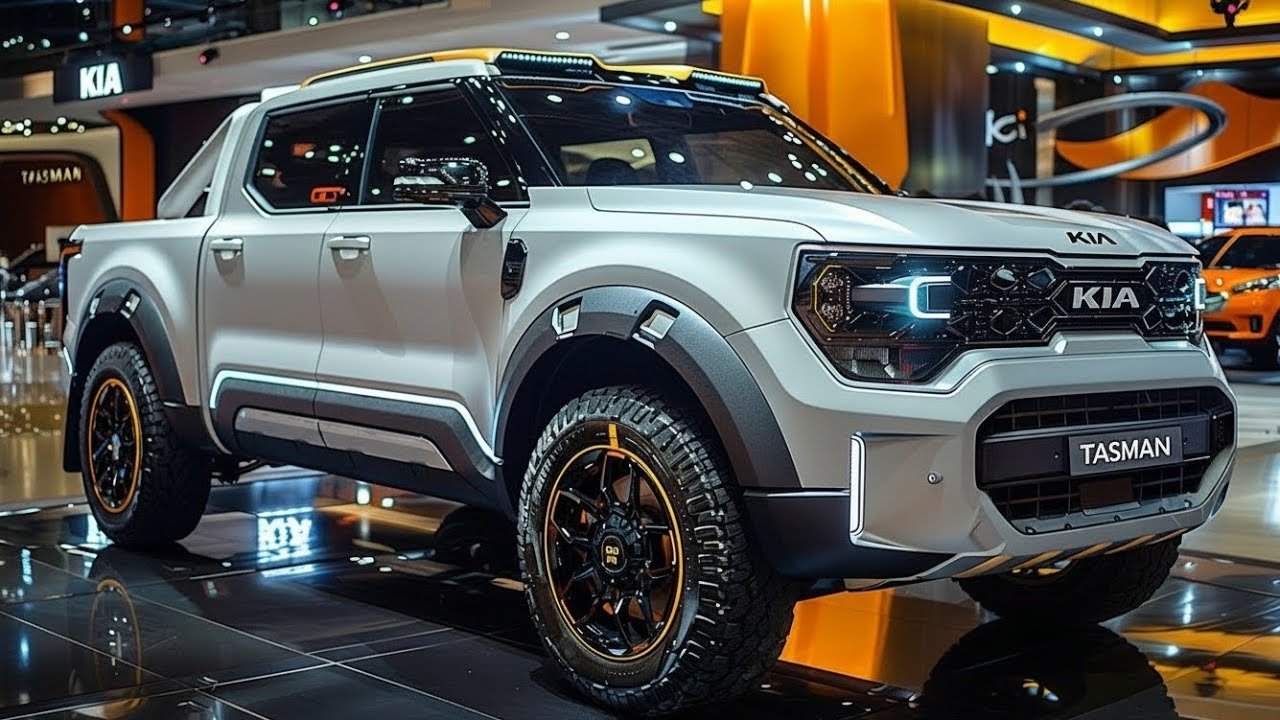
The global midsize pickup is a stronghold long held by stalwarts such as Toyota, Ford, and Isuzu. In 2026, a brawny upstart is about to breach the gates: the Kia Tasman. Following years of spy shots, teasers, and guessing, the first Kia body-on-frame pickup is almost ready for the global launch, and it’s built to battle from day one.
This isn’t a converted SUV/crossover or light commercial vehicle; the Tasman is Kia’s full-blooded, ground-up attempt to get a hold of the very profitable and brand-loyal market for utes. From the most anticipated new truck of 2026, here’s everything we think we know about it.
Design: “Opposites United” Meets Rugged Utility
The Tasman will take Kia’s contemporary “Opposites United” design philosophy and mold it into a durable and practical pickup.
- Front End: Expect a bold, upright take on Kia’s signature “tiger nose” grille, flanked by striking vertical or horizontal LED headlights. The styling will be muscular, yet refined, setting it apart from more functional competitors.
- Profile & Stance: A traditional double-cab form with a long bed, defined wheel wells, and a high beltline. Kia is aiming for a simple, technical design that works in urban environments and rugged, outdoorsy trails.
- Bed Innovation: While Kia is tight-lipped, it has a reputation for clever packaging. Find integrated bed features such as movable tie-downs, a 120V power outlet and multi-position tailgate as some of the company’s strategies for attracting practical buyers.
“Powertrain & Platform: Based on a Rugged, Battle-Hardened Platform”
So for quick cred the Tasman is said to share its basic architecture with a proven global platform.
- The probable platform: There is much speculation that the next gen Mohave will be based on a revised version of the Hyundai’s Mohave (or a new gen ladder frame) platform with new design elements. That makes it a genuine, body-on-frame mule right out of the gate.
- Engine Choices: But variety is the spice of life:
- 2.2L Turbo-Diesel: A torquey, fuel-efficient turbodiesel will serve as the main engine option in most markets, including Europe and Australia where strong towing and hauling figures are expected.
- 3.8L V6 Petrol: A potent V6 petrol engine will provide smooth and plenty of power in “regions” such as the Middle East and maybe as a top-of-the line substitute option in other markets.
- The Hybrid Future: A hybrid or plug-in hybrid version is nearly guaranteed within the first few model years, which will be consist with Kia’s aggressive electrification strategy.
Interior and Technology: A Kia Cabin in a Pickup
This is where the Tasman can bring the house down. The design and technology inside will reflect longstanding design development within Kia – offering a leap forwards, cabin quality-wise, for the segment.
- Digital Cockpit: A fully digital instrument cluster along with a wide, curved panoramic screen displaying the latest version of Kia’s user-friendly infotainment system will take center stage. Wireless Apple CarPlay and Android Auto come standard.
- High-Quality Materials: Kia will apply its expertise in upmarket style (as demonstrated by the Telluride and EV9) to deliver a cabin with superior materials, improved sound insulation, and more comfortable seats than many long-established rivals.
- Modernized Driver Assistance: Also coming is the entire package of Kia’s semi-autonomous Highway Driving Assist (HDA), plus a 360-degree camera, and high-end parking assist.
Capability & Off-Road Prowess
It must meet or outclass certain benchmarks for the Tasman to compete.
- Focused Towing And Payload: Anticipate competitive figures, aiming for a max towing capacity of no less than 7,700 lbs (3,500 kg)and a payload capacity in excess of 1,985 lbs (900 kg).
- 4WD System: A strong part-time 4WD system with low range and three terrain modes (Mud, Sand, Snow) is also available. An electronic locking rear differential might be standard on high, off road-focused trims.
The Competition & The Verdict The Contest & The Rating
The Tasman will compete in a very competitive environment, going up against the Toyota Hilux, Ford Ranger, Isuzu D-Max and Nissan Navara.
- Kia’s ace in the hole: The Tasman’s trump card is likely to be its potentially class-leading interior refinement, state-of-the-art technology, and striking design. Kia’s approach will be to give more features, more of a premium feel, and a compelling warranty for roughly the same price — a formula that’s worked brilliantly for its SUVs.
The Kia Tasman 2026 is Your Best Pick for:
- The Brand-New Truck Buyer: A consumer new to the segment who isn’t emotionally tied to an established marque and motivated by contemporary design and tech.
- The Lifestyle User: The buyer who goes out into the wild not simply as inspiration for a daily work truck but duty as a daily work truck and needs a comfortable, connected cabin as much as payload capacity.
- The Value Seeking Fleet Manager: Who wants a robust, feature rich workhorse that delivers on fuel efficiency and is supported by a comprehensive warranty.
The 2026 Kia Tasman is a lot more than a new model—it’s a powerful message. Rugged Kia had plenty of announcements at its press conference, including its first ever mid-size pickup truck, which pairs rugged capabilities with Kia’s signature style and technology, could disrupt the global pickup truck order and become an instant heavyweight contender.